Agents Are Ready to Pay. The Web Is Ready to Sell. PayOS + Browserbase Make It Real.
PayOS and Browserbase are partnering to close the last gap in agentic commerce: agents that can reach any website and pay on it, securely.

PayOS and Browserbase are partnering to give AI agents everything they need to make purchases: a trusted payment credential to fund the transaction, and a browser to navigate the checkout flow.
AI agents have graduated from answering questions to completing tasks. They research, compare, negotiate, and decide. But at the moment of purchase, most agents still hit a wall. They either stop and hand the task back to a human, or they improvise with credentials that were never designed for autonomous software.
How most AI assistants handle payments today
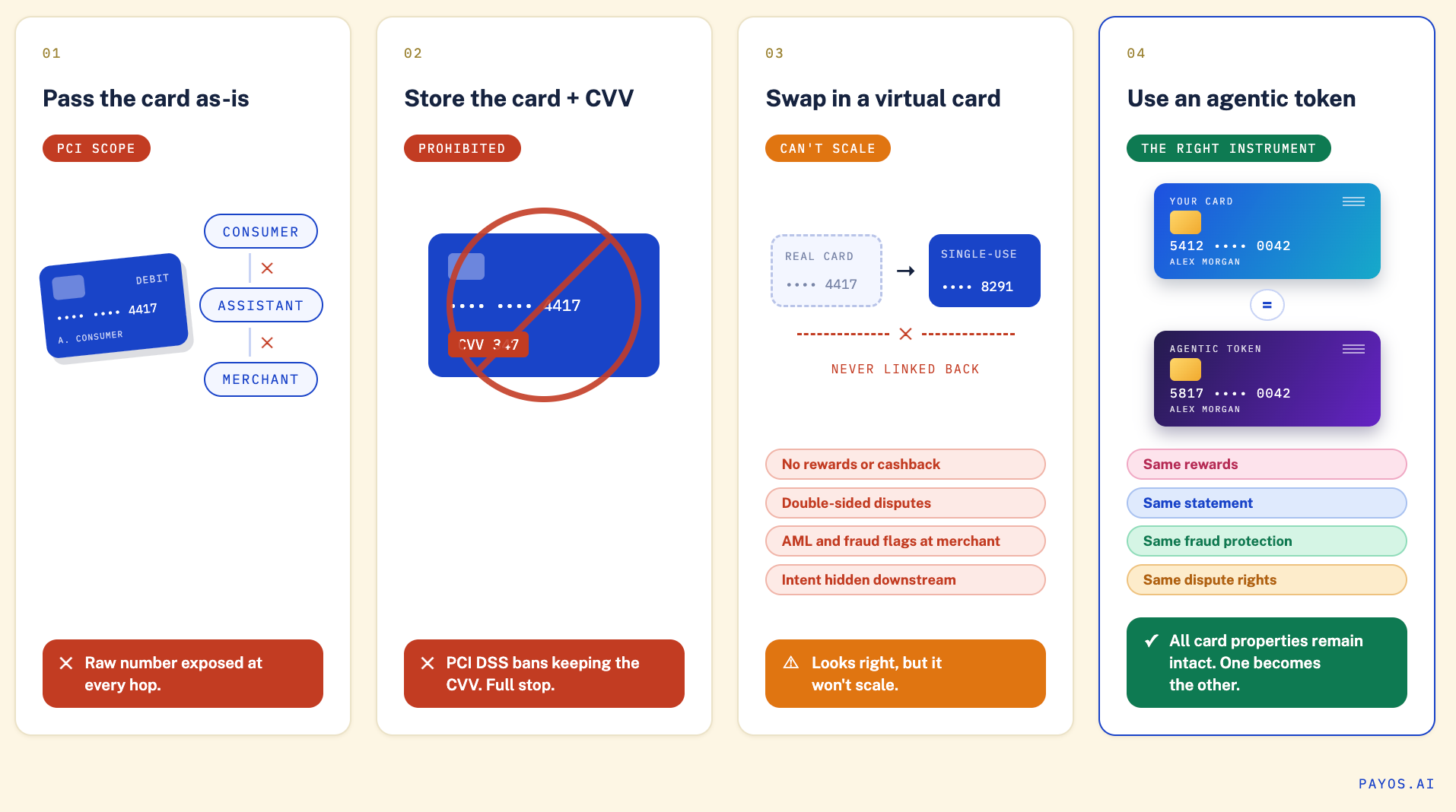
When an AI assistant needs to complete a payment today, it typically reaches for one of three approaches, and each one goes wrong:
- Taking the consumer’s card as-is and passing it to the merchant. This drags the assistant into PCI scope it was never designed for and exposes raw card data at every hop.
- Storing the card and CVV for recurring purchases. PCI DSS prohibits storing the CVV after authorization. An assistant that keeps it on file is sitting on a compliance nightmare.
- Converting the card into a one-time virtual card. The purchase runs on a disposable number, so the transaction is never matched back to the consumer’s actual card.
That third approach looks like a good solution from the outside. It just cannot scale, and it causes more issues than it solves: no rewards, double-sided disputes, AML and velocity triggers at the merchant, and obfuscation of intent from everyone downstream.
What agentic commerce actually needs
- A way for agents to pay that merchants, issuers, and networks can trust.
- A way for agents to shop across the real web, where most checkout flows do not have an API.
PayOS solves the first problem, while Browserbase solves the second. Together, they form a complete, production-ready stack for agent-driven payments.
Part 1: Agents need a way to pay
Handing an agent a stored card number is a non-starter. The card was issued to a person, not a piece of software, and nothing in the transaction tells the merchant or the issuer that an agent is involved, what it was authorized to do, or on whose behalf it is acting.
What agentic tokens are
Agentic tokens are payment credentials issued through the card networks themselves, purpose-built for AI agents. Instead of masking a card number, the network provisions a token that carries the context of the transaction: the agent requesting it, the consumer or business that delegated authority, and the boundaries of that delegation.
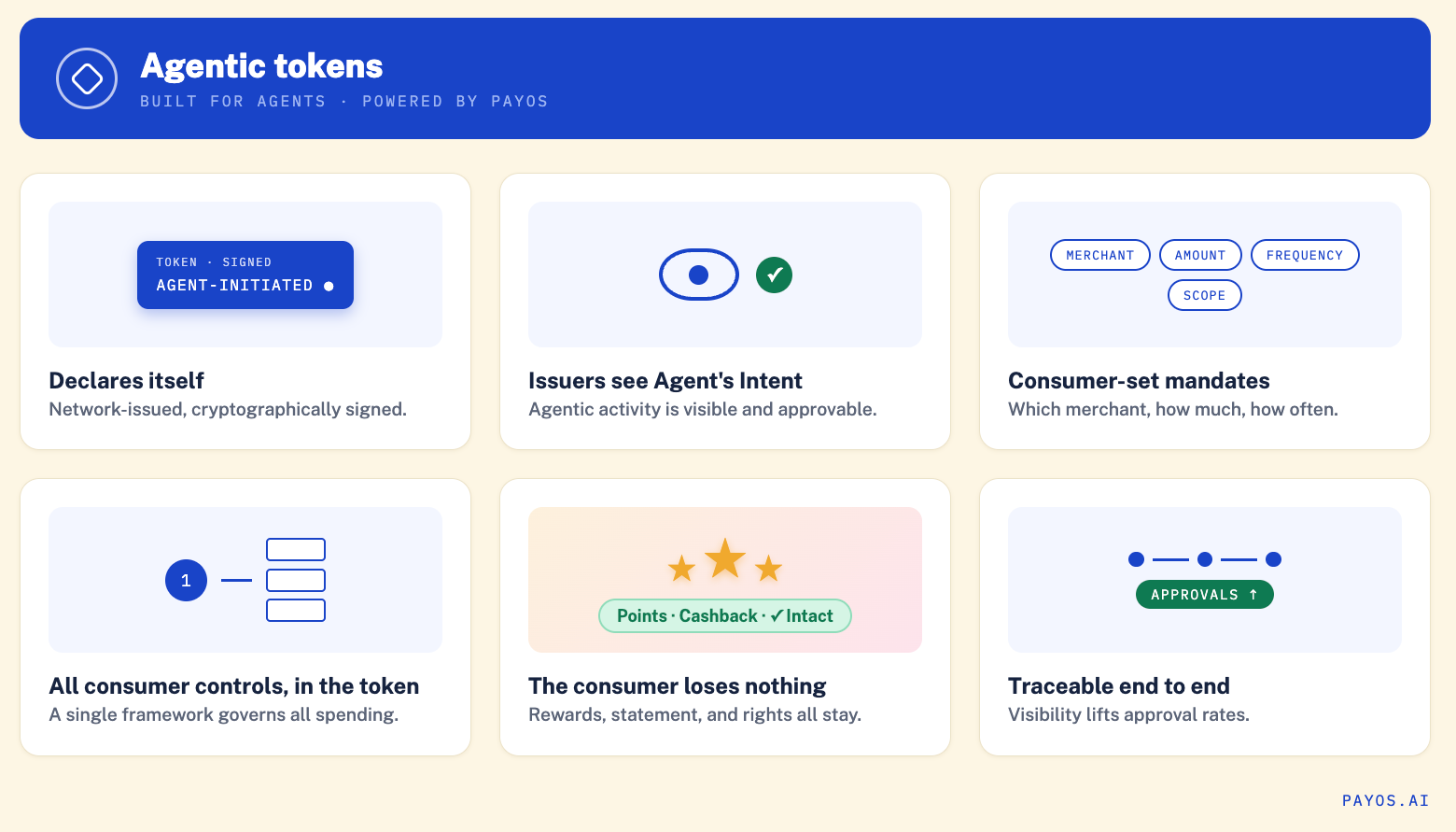
PayOS completed one of the first live agentic payment transactions using a Mastercard Agentic Token, a milestone that proved network-issued credentials can power real, end-to-end agent purchases.
- Consumers and businesses delegate spending with explicit, revocable intent instead of surrendering raw card credentials.
- Merchants can recognize and welcome agent traffic rather than fighting it with bot defenses.
- Issuers and networks get visibility into agentic volume and can build risk models around it instead of guessing.
Where PayOS fits
PayOS is the payments intelligence layer for the agentic economy. We handle the provisioning, lifecycle, and intelligence around agentic tokens: requesting and provisioning network tokens for your agents, binding them to consumer or business payment intents, and enriching every transaction with card, bank, and merchant data.
Part 2: Agents need a way to shop
A credential alone does not complete a purchase. Once an agent can pay, it still has to find the product, navigate the merchant’s site, fill the checkout form, and submit the order. And here is the inconvenient truth about the internet: most of the web does not have an API.
Why Browserbase
Browserbase is the complete platform to run agents that use the web like humans. It gives agents cloud browsers that spin up in milliseconds, hold state across a session, and behave like real browsers because they are real browsers:
- Serverless browser sessions that scale from one checkout to thousands of parallel workflows.
- Stagehand, Browserbase’s open-source framework, which lets agents drive the browser with natural-language actions like act, extract, and observe.
- Persistent, authenticated sessions so agents can log in, hold a cart, and complete multi-step flows.
- Session recordings and live view so every agent purchase is observable, replayable, and auditable.
When an agent spends money, you want a complete record of what it saw and did. Browserbase makes every transaction a documented, reviewable event, which pairs naturally with the accountability agentic tokens bring on the credential side.
Part 3: Build it today
Step 1: Set up PayOS
Create an account at platform.payos.ai, generate API keys, establish the payment intent (who is delegating spend, the merchant scope, the limits), and request an agentic token. PayOS handles network provisioning across Visa and Mastercard.
Step 2: Set up Browserbase
Create an account at browserbase.com, grab your API key, and install Stagehand:
npm install @browserbasehq/stagehand
Step 3: Put them together
// 1. Navigate and shop
await page.goto("https://merchant.example.com");
await stagehand.act("search for noise-cancelling headphones under $300");
await stagehand.act("add the top-rated result to the cart");
await stagehand.act("proceed to checkout");

// 2. Fetch the payment credential from PayOS
const credential = await payos.paymentCredential.create({
  paymentIntentId: PAYMENT_INTENT_ID,
  amount: 30000, // cents
  merchant: "merchant.example.com",
});

// 3. Complete checkout with the agentic token
await stagehand.act("fill the card, expiry and cvc fields", {
  variables: {
    cardNumber: token.pan,
    expiry: token.expiry,
    cvc: token.cryptogram,
  },
});
await stagehand.act("place the order");

// 4. Confirm and record
const confirmation = await stagehand.extract("the order confirmation number");
The division of labor is clean: Browserbase handles everything the agent sees and touches on the web, and PayOS handles everything the agent presents and proves at the moment of payment. The session recording plus the payment intent gives you a complete, auditable trail for every agent purchase.
Part 4: The intelligence behind every agent transaction
A credential gets an agent through checkout. Intelligence keeps it out of trouble. Every agent built on PayOS has access to the full PayOS intelligence suite.
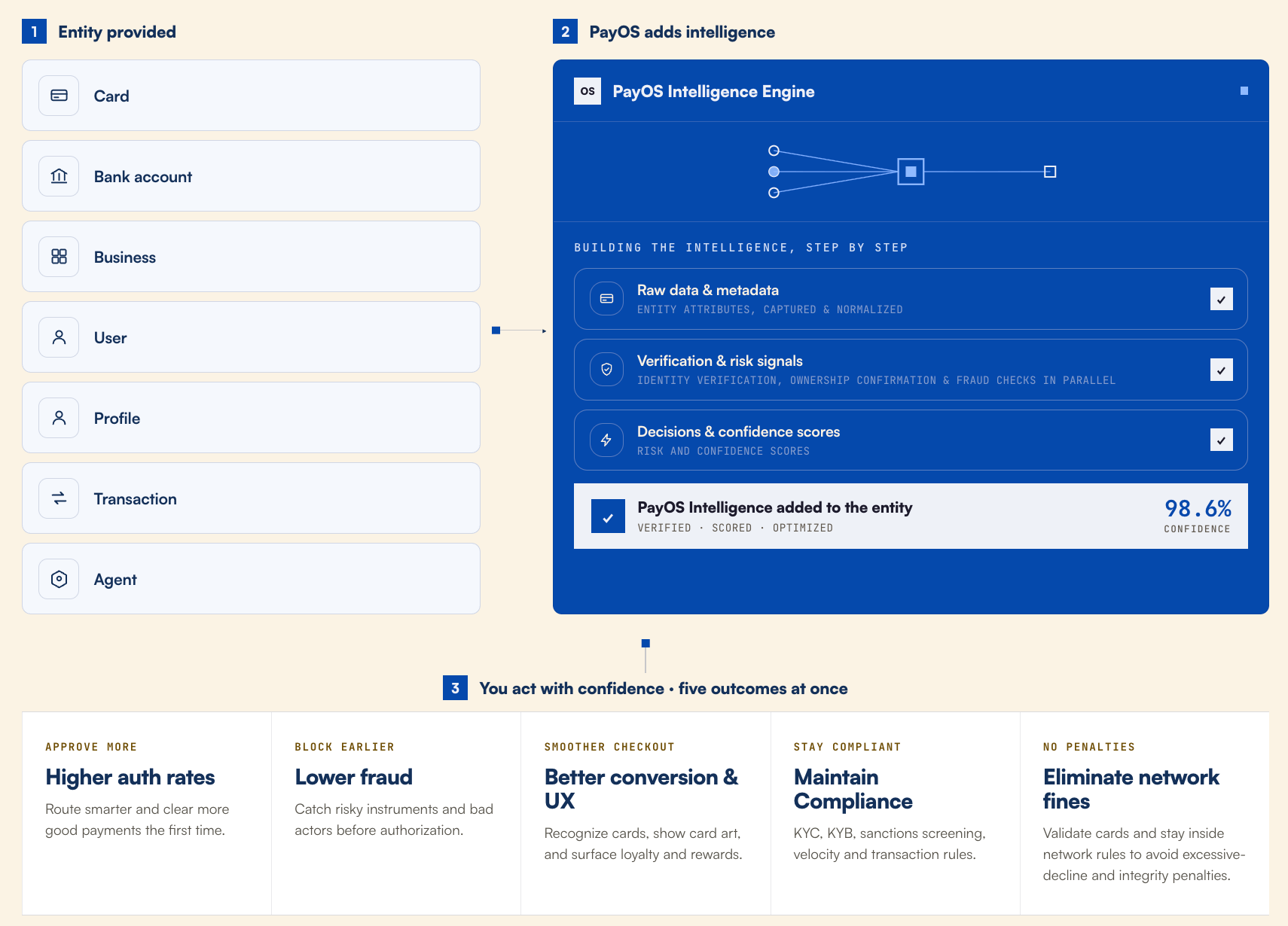
- Card Data: issuer, network, card type, and funding details, plus deep attributes and PAR-based identity resolution across tokens.
- Business Data: verified merchant identity before an agent ever enters a checkout flow.
- Bank Account Intelligence: real-time validation of account status and ownership across domestic and global rails.
Part 5: The use cases we expect to take off first
- Personal shopping agents that watch prices and complete the purchase the moment the target is hit.
- Travel booking agents working across dozens of sites that have no public API.
- Subscription and bill management: audit recurring charges, cancel, renegotiate, and pay without ever holding a real card.
- B2B procurement: vendor portals, quotes, purchase orders, and invoices with business-grade mandates.
- Recurring replenishment governed by a standing token instead of a drawer full of one-off virtual cards.
- Rewards-optimized checkout: pick the right card for the purchase, then capture every point and perk.
The agentic economy has a payments stack now
Agents that can browse but not pay are researchers. Agents that can pay but not browse are stranded. With PayOS and Browserbase together, agents can finally do both, with the trust, transparency, and auditability that consumers, businesses, merchants, and networks all require.